+86-0571-82795522

 LANGUAGE
  English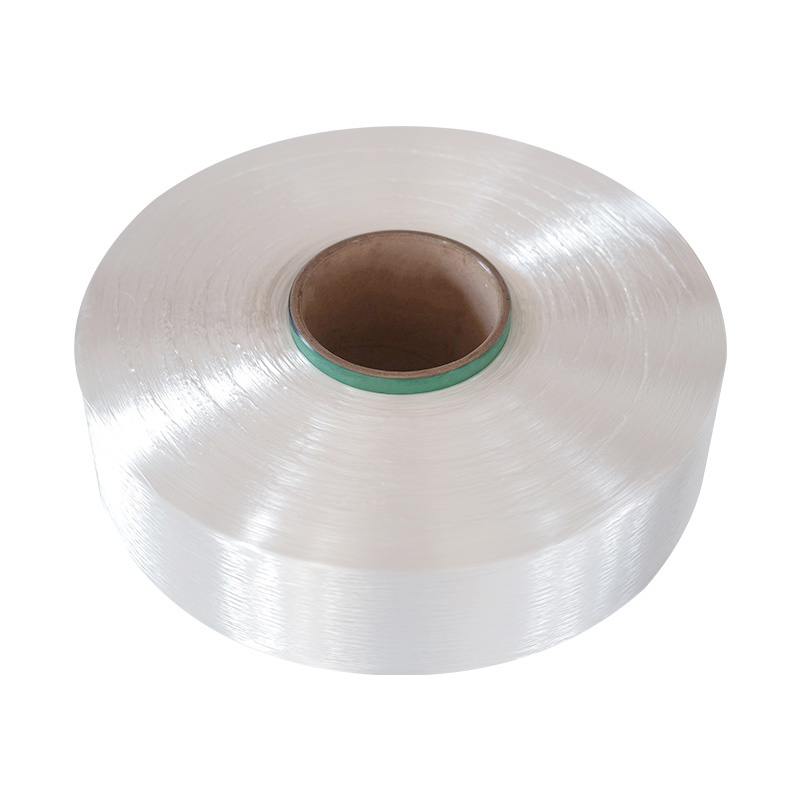
The Stretch Fiber Problem in a Circular Economy
Spandex, also known as elastane, is the default stretch solution across modern apparel. It appears in around 80 percent of garments, usually at 2 to 8 percent of fabric weight. Despite its small share, this fiber creates a disproportionate recycling burden.
Any fabric containing spandex is commonly excluded from fiber-to-fiber recycling. Spandex decomposes below the melting range of mainstream polyester, contaminates recycled batches, and lacks a commercial chemical recovery route. Most stretch garments therefore end in landfill, incineration, or low-value downcycling.
Apparel brands and textile producers are now evaluating a spandex alternative recyclable yarn that can deliver practical elasticity, survive multiple recovery loops, and integrate with existing polyester recycling systems. European regulatory frameworks are moving toward mandatory design-for-recyclability rules for textiles, and large retailers already use recyclability as a procurement criterion. This article explains why spandex resists circularity, which performance targets matter, which recyclable yarn technologies exist today, and how to manage a credible switch.
Why Spandex Defeats Conventional Recycling
Understanding the failure modes of spandex helps a development team set realistic targets for a recyclable alternative.
Thermal Instability During Melt Processing
Spandex is a segmented polyurethane. Hard segments provide tensile strength; soft segments provide elasticity. During melt processing of blended textile waste, the polyurethane phase degrades at temperatures well below the processing range of polyester, producing off-odours, discolouration, and brittle fragments that ruin the extruded filament.
Contamination of Polyester Recyclate
At a content of only 2 to 5 percent, spandex lowers the intrinsic viscosity of recycled PET and creates visible gels or haze. Optical and near-infrared sorting systems cannot reliably identify low-level elastane, so contaminated bales pass into reclaim lines and compromise entire production lots. The damage is not limited to one batch, because reclaimers blend failed lots with fresh material.
No Scalable Chemical Recovery Route
PET can be depolymerised into monomers and rebuilt, but polyurethane cannot. Pilot-scale glycolysis and solvent routes for spandex exist, yet none operate at the cost and volume needed for garment-level recovery. This asymmetry explains why recycled spandex remains a niche label rather than a circular solution. The same asymmetry is the reason a spandex alternative recyclable yarn must be melt-processable by design.
Energy and Microplastic Load
Spandex is solvent-spun, which makes it more energy-intensive than melt-spun polyester. During wearing and washing, elastane fragments into microplastics that are difficult for treatment plants to capture. These burdens continue across the full lifecycle of the product. Replacing spandex with a melt-spun recyclable yarn reduces primary energy demand at the fibre stage and removes a non-recyclable component from the final garment.
Defining the Performance Baseline for an Alternative
Not every garment requires 400 percent stretch. The majority of apparel needs comfort stretch of 15 to 40 percent, together with elastic recovery that prevents bagging and sagging. The table below provides a specification framework for comparing spandex with recyclable yarn candidates.
| Metric | Spandex Reference | Recyclable Yarn Target | Relevance |
|---|---|---|---|
| Elongation at break | 400 to 700 percent | 20 to 50 percent yarn; 15 to 35 percent fabric | Defines the usable stretch range |
| Elastic recovery | 90 to 95 percent at 50 percent strain | 85 to 95 percent at 15 to 25 percent strain | Prevents bagging and sagging |
| Wash durability | Stable when protected | Requires heat setting to stabilise crimp | Preserves garment shape across life |
| Melt processability | Decomposes before melting | Fully melt-recyclable | Enables a fiber-to-fiber loop |
| Recycled content | Rarely available | Up to 100 percent certified content | Supports environmental claims |
| Dyeability | Resists dye; often pre-coloured | Disperse dyeable | Simplifies colour development |
A robust test protocol includes elongation at a defined load, recovery after repeated cycling, bagging after 24 hours of compression, and dimensional change after laundering. Values must be recorded in both the machine and cross directions.
This table is not a claim that recyclable yarn matches pure spandex. It is a method for comparing measured values. Development teams should set a minimum threshold for each metric, then test candidate yarns at the fabric level rather than on a single-filament chart. A yarn with modest single-end recovery can still create a high-recovery fabric when knit density and heat setting are optimised.
Recyclable Yarn Technologies Available Today
Several yarn architectures provide recyclable stretch in real products today. The most relevant are recycled polyester filament, hollow crimped yarn, composite differentiated yarn, and emerging melt-processable polyolefin filament.
Recycled Polyester Filament with Texturing
False-twist texturing converts flat recycled PET filament into a bulky, crimped yarn. In a knit structure, the crimp produces two-way stretch of roughly 20 to 40 percent, with recovery driven by elastic bending of the filaments. Because the polymer remains standard PET, the yarn flows directly into established collection, sorting, and depolymerisation loops.
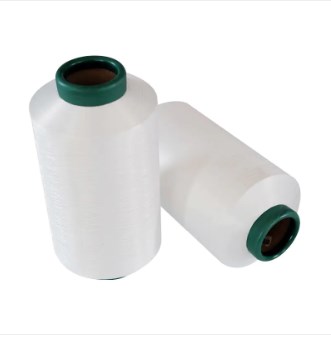
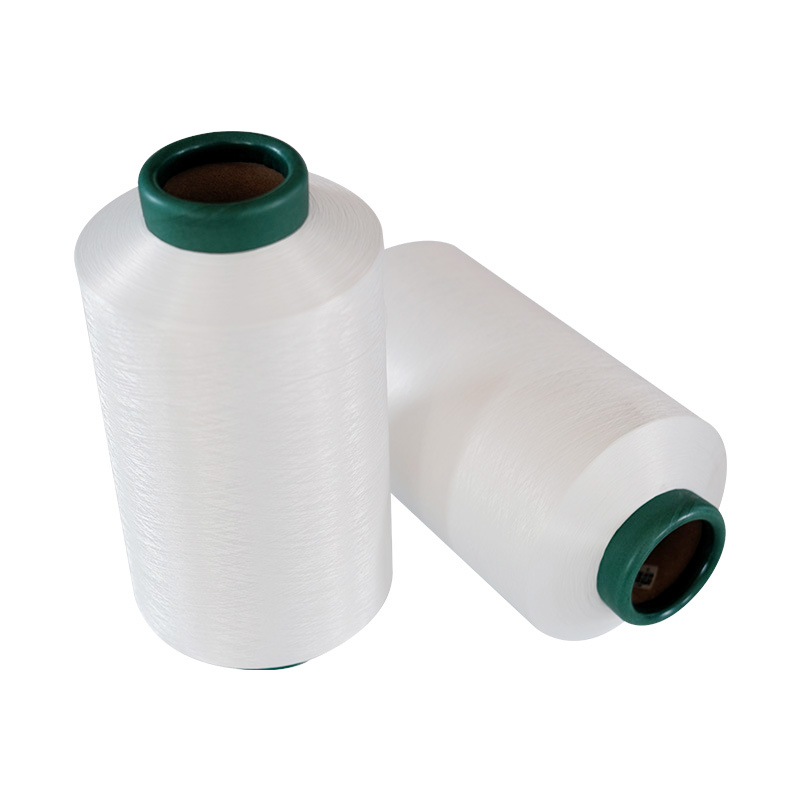
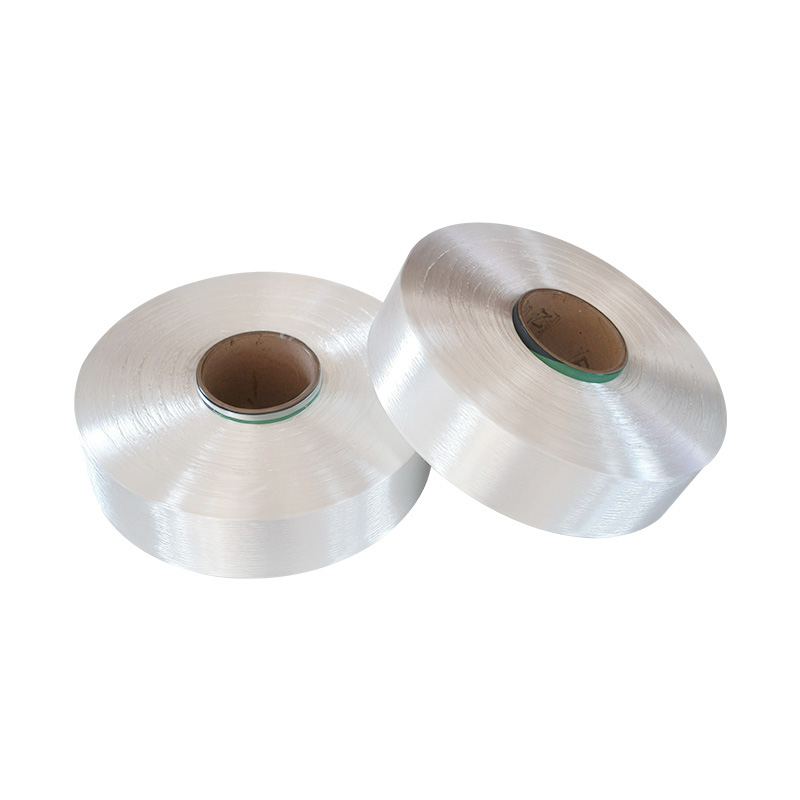 Recycled PET Yarn Series with Hollow Cross-SectionThis series features 100% recycled post-consumer PET yarns with a hollow cross-section that traps air, enhancing loft, moisture transport, and resilience. Ideal for athleisure and midlayers where spandex would block recyclability.View Product →
Hollow Crimped Yarns for Bounce and Breathability
A hollow cross-section traps air, improving loft, moisture transport, and compression resilience. The crimped geometry adds soft mechanical stretch and a dry, plush hand. These yarns suit athleisure, midlayers, and knit outerwear where spandex retains heat and blocks recyclability.
Composite Differentiated Yarns with Latent Crimp
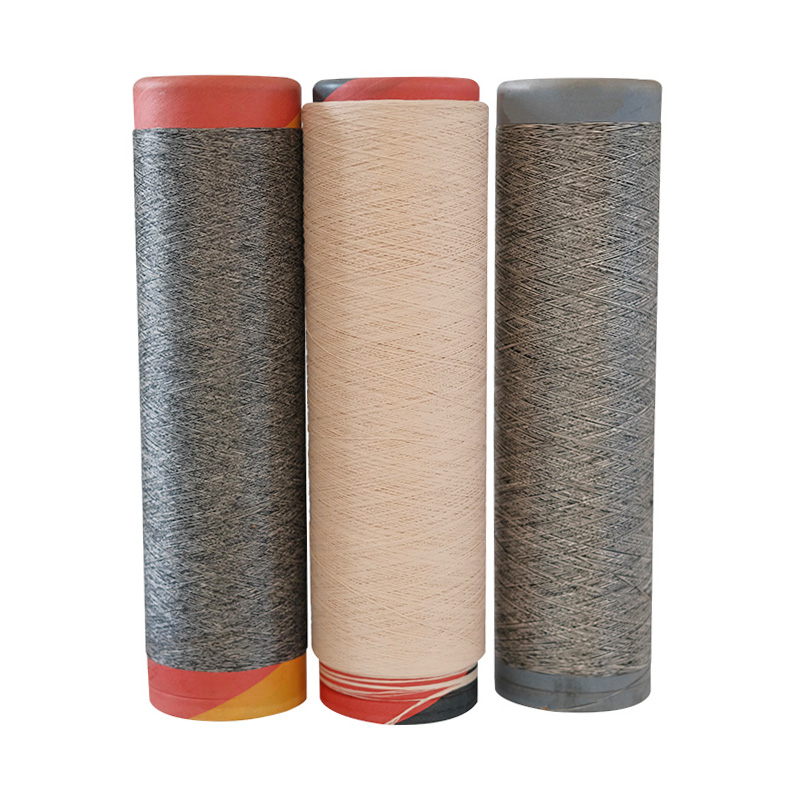
Composite spinning combines two polymers with different shrinkage or modulus in a single filament bundle. Heat setting activates the difference, creating a latent crimp that delivers stretch and recovery similar to spandex blends. This architecture allows elasticity to be positioned only where the garment needs it.
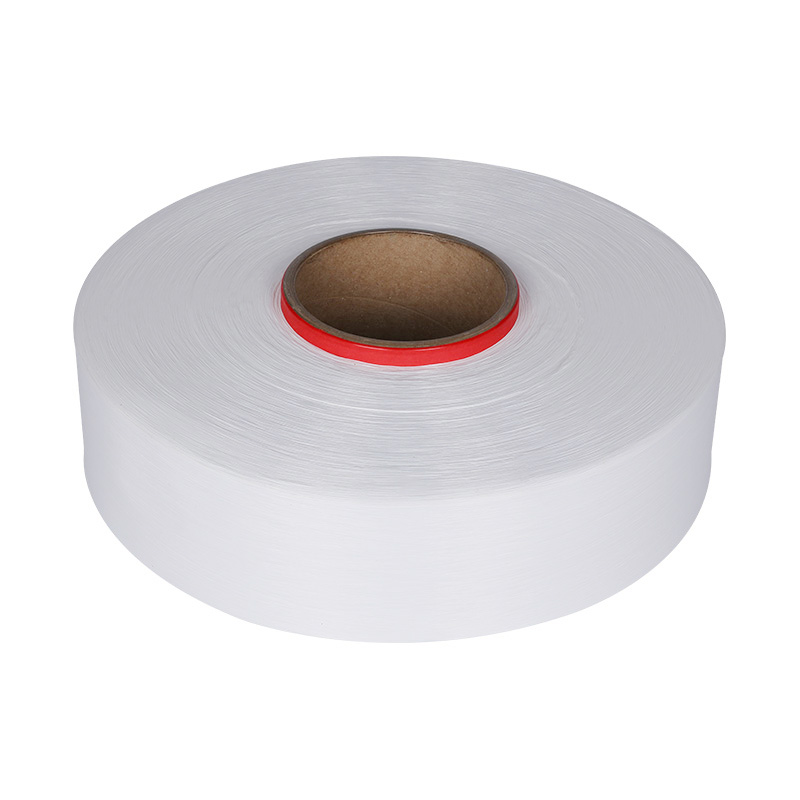
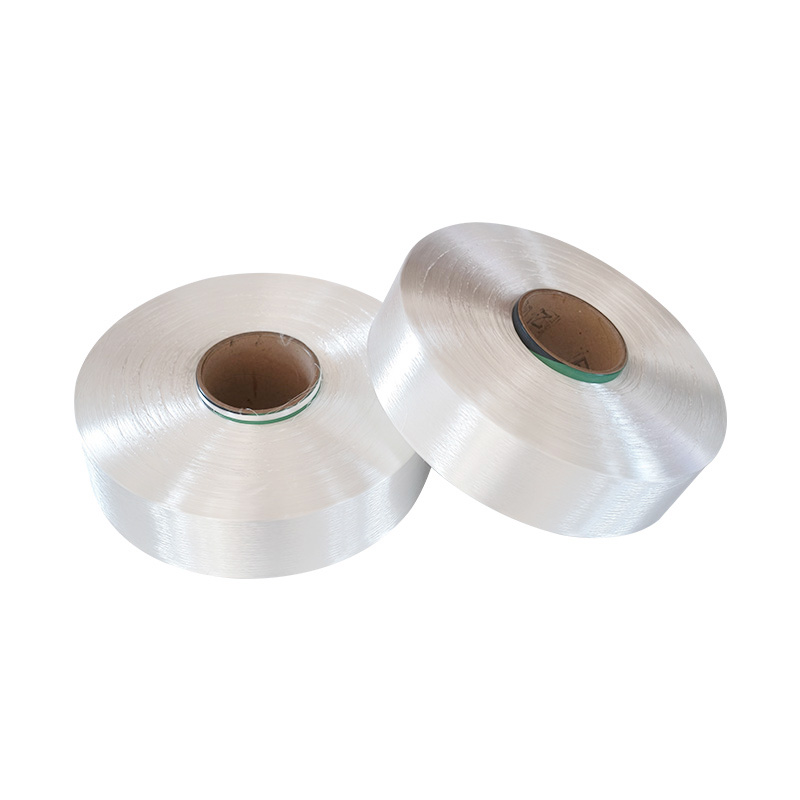
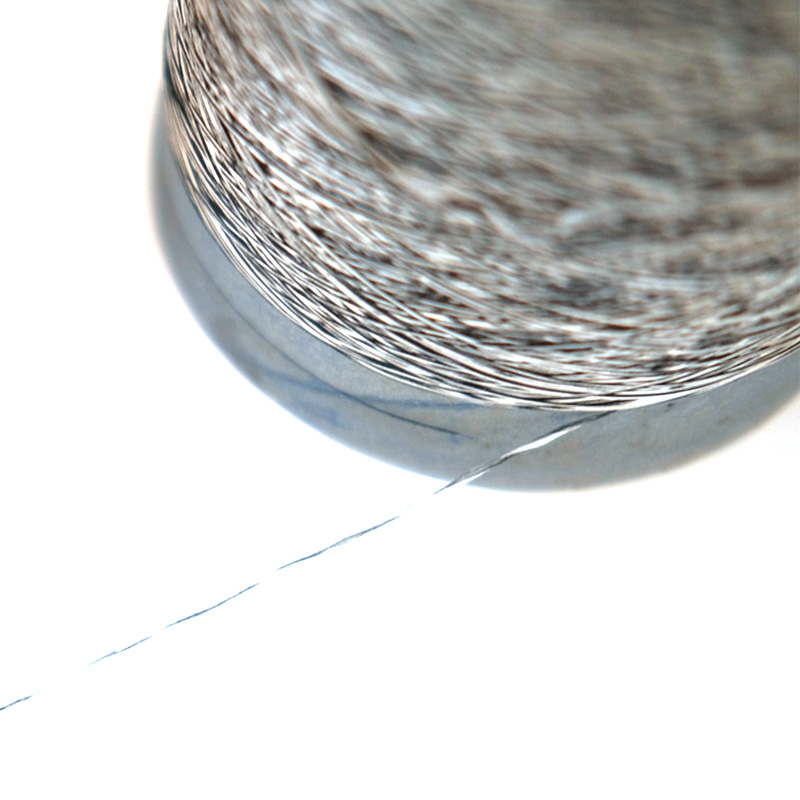 Composite Differentiated Yarn Series with Latent CrimpThese yarns combine two polymers to create latent crimp, offering stretch and recovery similar to spandex blends. Positioned for garments requiring targeted elasticity without compromising recyclability.View Product →
Knit Construction as an Elasticity Multiplier
Fabric structure contributes as much as the yarn. Ribs, interlock variations, and laid-in crimped filaments multiply apparent stretch, while heat setting locks in the geometry. Many garments that consumers perceive as stretchy contain no elastane at all; they achieve their ease through structure.
Emerging Melt-Processable Polyolefin Yarns
Recent research demonstrated that a commodity polyolefin filament can be extruded with elongation approaching spandex while remaining melt-reprocessable. The yarn kept its stretch performance through repeated re-spinning cycles. The key finding is behavioural: melt-processability and elasticity can coexist in a single filament, which changes the long-term material selection logic for stretch garments. The material is not yet a commercial apparel option, but it confirms that recyclable elasticity depends on polymer engineering, not on a special chemistry class.
None of these yarns is a drop-in replacement for spandex in every style. Selection depends on the final garment's elongation requirement, the fabric structure, and the certifications the buyer must display.
Benchmarking Performance Across Real Garment Categories
Recyclable yarn will not replace spandex in every application. The table below gives realistic expectations for five common categories.
| Application | Spandex Blend Baseline | Recyclable Yarn Substitute |
|---|---|---|
| Comfort knit T-shirt | Good recovery at low strain | Fully suitable with textured knit and heat set |
| Leggings with 15 to 30 percent stretch | Excellent fit retention | Suitable with hollow crimped yarn |
| Stretch denim | Strong recovery but not recyclable | Recyclable when weave construction provides stretch |
| Compression sportswear | High tension and compression | Not recommended for true compression zones |
| Outdoor shell trousers | Stretch mobility | Works with articulated patterning plus crimped yarn |
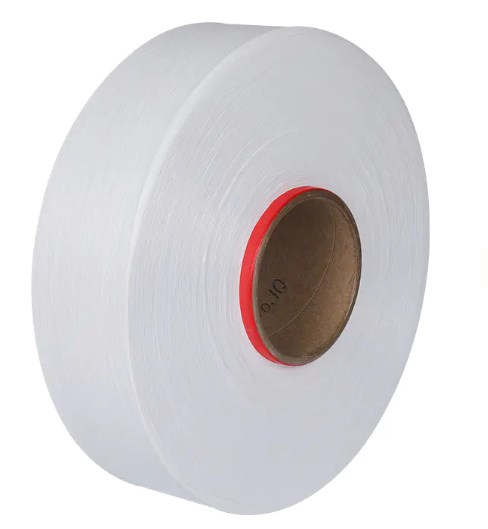
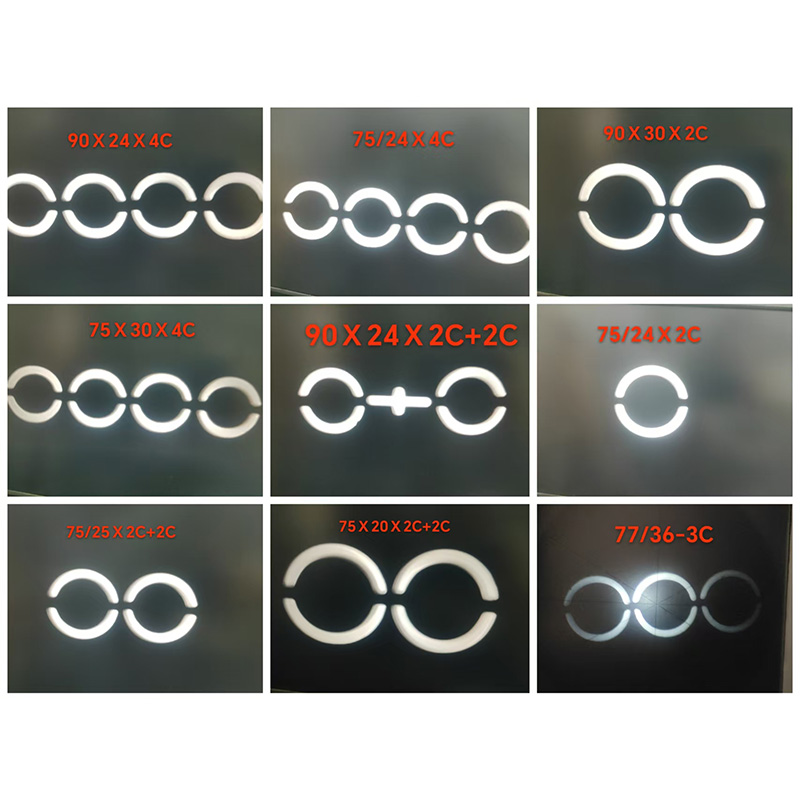 HOY Hollow Crimped Yarn Series for Moderate StretchThis series suits applications needing, at most, 40% elongation, where current recycled alternatives are sufficient. With a hollow rate ≥25% and enhanced resilience, it is ideal for sportswear and insulation.View Product →
A practical rule: classify garments by required elongation. Below 40 percent, recycled filament yarns can compete. Above 40 percent, current recycled alternatives are rarely sufficient.
The chart makes a structural gap visible. Pure spandex operates far beyond the range that most garments actually use. Recycled filament yarns cover the comfort-stretch zone where most T-shirts, trousers, dresses, and lightweight outerwear sit. These percentages are not fixed boundaries; they are engineering starting points. By adjusting stitch density, yarn count, and finishing route, a development team can shift the comfort-stretch window by about 10 percentage points in either direction. The engineering task is to move elasticity from the chemistry of the fibre to the architecture of the yarn and the fabric.
Certification, Traceability, and Claim Validation
A recyclable yarn creates value only if its environmental claims can be verified. The Global Recycled Standard is the most widely used certification for recycled fibres in apparel, covering recycled content, chain of custody, social compliance, and chemical use.
The due-diligence list should include:
- Lot-level recycled content percentages, not a factory annual average
- Chain-of-custody certificates that trace the material from reclaim to finished yarn
- Composition and contaminant test reports for every delivery batch
- Wash-durability data for stretch recovery after 20, 30, and 50 cycles
- A garment-level recyclability assessment based on the final fabric blend
One common confusion is mass balance accounting. Some suppliers offer recycled content certificates based on mass balance rather than a physically segregated fibre stream. For marketing claims and retailer compliance, confirm whether the product is segregated or mass-balanced. Certification audits add time and cost, but they also protect buyers from soft claims; a verifiable certificate is the only robust defence in a supply chain where recycled and virgin materials carry different prices.
Certification alone does not prove performance. Pair it with fabric-level testing, because stretch and recovery are system properties created by yarn, structure, and finishing together.
For further background on how recycled filament development supports circular design, read our analysis of recycled yarn and the future of textile circularity.
How to Evaluate a Recyclable Yarn Supplier
Supplier assessment should go beyond price per kilogram, because crimp quality and certification depth directly affect the final fabric.
- Verify the GRS certificate scope and its current renewal date
- Confirm that recycled content is documented per production lot
- Assess texturising and drawing capability, since crimp uniformity controls end-product stretch
- Check response time for development samples and technical data sheets
- Confirm logistics arrangements that allow pilot quantities before scale-up
A capable supplier works as a development partner during the first 12 months, supporting fabric testing, heat-setting adjustment, and documentation for retailer compliance schemes. In practical terms, the evaluation should include a pilot order of 200 to 500 kilograms, enough to run a single style. Ask for the test data associated with that lot, including the recommended heat-setting window and dyeing conditions. The supplier that can document these parameters usually delivers more consistent downstream results.
A Structured Roadmap for Switching from Spandex
The following sequence reduces the technical and commercial risk of replacing spandex with recyclable yarn.
- Audit your garment range and classify each style by required elongation.
- Begin with the 15 to 40 percent comfort-stretch group, where recycled crimped filament performs best.
- Produce prototype knit or woven panels, then test stretch, recovery, and bagging after washing.
- Optimise stitch density, fabric structure, and heat-setting conditions before changing yarn count.
- Verify GRS documentation and recycled content certificates for each production lot.
- Run wearer trials for comfort, fit retention, and care response.
- Execute a factory-scale pilot on one style before broad roll-out.
The most common mistake is testing the yarn in isolation. A modest yarn can generate a high-recovery fabric if the construction adds auxiliary elasticity, while a good yarn can fail in a poorly engineered construction. Always test at the fabric level. Document every decision, because the knowledge generated during the pilot becomes the specification for future styles.
Frequently Asked Questions
Q1: Can recyclable yarn fully replace spandex in every garment?
Not in every garment. In the comfort-stretch window of 15 to 40 percent elongation, recycled polyester filament, hollow crimped yarn, and composite differentiated yarn are practical substitutes. For compression garments that require 200 percent or more extension, spandex remains technically necessary.
Q2: What is the difference between recycled yarn and biodegradable yarn?
Recycled yarn returns used material to a new product and extends the material cycle. Biodegradable yarn is designed to break down under specific environmental conditions. Recyclability and biodegradability serve different end-of-life strategies and should not be treated as interchangeable sustainability claims.
Q3: How does fabric construction create stretch without spandex?
Knit structure is the main driver. Longer floats, higher stitch density, and laid-in crimped filaments increase fabric stretch and recovery. Heat setting locks in the crimp geometry. In woven fabrics, weave crimp alone can deliver 10 to 20 percent stretch.
Q4: What recycled content can a certified yarn actually contain?
Under the Global Recycled Standard, recycled polyester filament from post-consumer bottles or post-industrial waste can carry up to 100 percent certified recycled content. Some buyers select a 50 or 70 percent blend to balance cost and supply reliability. The certificate must reflect the real lot-level percentage.
Q5: How durable is stretch recovery after repeated washing?
Properly heat-set recycled crimped yarn typically retains 85 to 95 percent of its initial recovery after 50 wash cycles. Critical variables are crimp stability, dyeing temperature, and drying conditions. Every garment should be validated against its actual wash and care protocol.
Q6: Does replacing spandex change how a garment should be designed?
Yes. Pattern cutting and seam construction require adjustment. Garments should rely on the fabric's engineered stretch range, while woven or fused panels support areas that need stability. Design teams should revise the block pattern before assuming a new fabric will behave like a spandex blend.